Editorial Annotation
Definition of Official
Introduction
This section defines an official as a peace officer, public officer, member of the Canadian Forces, or anyone who exercises similar powers in a foreign state.
Statutory Text
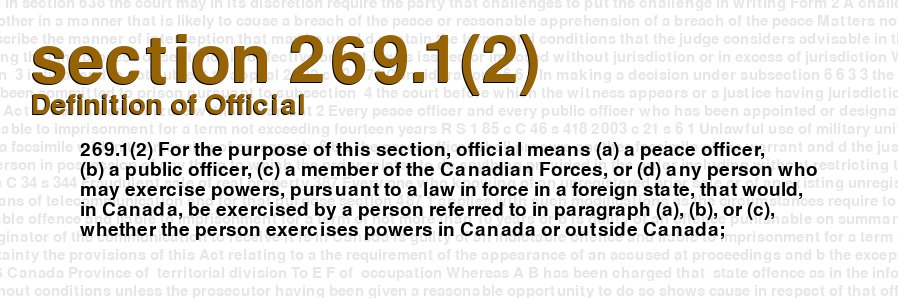
269.1(2) For the purpose of this section, "official" means (a) a peace officer, (b) a public officer, (c) a member of the Canadian Forces, or (d) any person who may exercise powers, pursuant to a law in force in a foreign state, that would, in Canada, be exercised by a person referred to in paragraph (a), (b), or (c), whether the person exercises powers in Canada or outside Canada;
Explanation
Section 269.1(2) of the Criminal Code of Canada provides a definition for the term "official" in relation to an offense of obstructing, resisting, or assaulting a peace officer or public officer. Essentially, this section defines who or what constitutes an official for the purposes of this offense. The definition includes peace officers, public officers, and members of the Canadian Forces. It also includes any person who is able to exercise powers similar to those of a peace officer, public officer, or member of the Canadian Forces under a law in force in a foreign state.
By including this definition of "official," the section aims to ensure that individuals can be held accountable for obstructing, resisting, or assaulting anyone who has been given powers or authority to uphold the law. This helps to protect those who are entrusted with upholding the law and maintaining public safety. Additionally, this section makes it clear that committing such an offense against any individual who has been granted powers under a foreign law is also a serious matter, even if the offense occurs outside of Canada.
Overall, Section 269.1(2) of the Criminal Code of Canada plays an important role in defining who qualifies as an official and ensuring that anyone who obstructs or resists these individuals is held accountable for their actions. It reinforces the importance of respecting law enforcement and those in positions of authority, both at home and abroad.
Commentary
Section 269.1(2) of the Criminal Code of Canada defines the term "official" for the purposes of the section which deals with assaults on peace officers, public officers, and members of the Canadian Forces.
In order to understand the significance of this section, it is important to examine the broader context of the section and its purpose. Section 269.1 is a provision that makes it a criminal offence to assault an official in the course of their duties. This offence is considered more serious than a regular assault because it targets individuals who are carrying out important public functions and whose safety is essential to the proper functioning of society.
By defining the term "official" to include peace officers, public officers, members of the Canadian Forces, and individuals who exercise powers under foreign law equivalent to those of Canadian officials, the section ensures that a wide range of individuals who perform important public functions are protected by the provision.
The inclusion of peace officers in the definition is particularly significant. Police officers are often the first line of defense against criminal activity and are required to frequently put themselves in harm's way to protect the public. Assaults on police officers can disrupt investigations, undermine public safety, and have a chilling effect on law enforcement more broadly.
Similarly, public officers, such as corrections officers, court officials, and government employees, perform essential duties that require them to interact with the public in potentially volatile situations. Assaults on these individuals can impede the functioning of the justice system and have significant consequences for public safety.
Members of the Canadian Forces are also included in the definition. While they may not be directly involved in law enforcement activities, they play a critical role in protecting Canadian national security both domestically and abroad. Assaults on members of the military can undermine Canada's ability to defend itself and uphold its international obligations.
Finally, the inclusion of individuals who exercise foreign powers equivalent to Canadian officials ensures that the provision has a broad reach and can be applied in cases involving individuals who may not be Canadian citizens or may be operating outside of Canada.
Overall, the definition of "official" in Section 269.1(2) is an important part of the broader effort to protect those who perform essential public functions from harm and ensure that the justice system can function effectively. By providing clear guidance on who is covered by the provision, the section makes it easier for individuals to understand their obligations and for law enforcement agencies to effectively enforce the law.
Strategy
Section 269.1(2) of the Criminal Code of Canada is a provision that is meant to protect officials from harm or threats of harm in the course of their duties. It includes a definition of official" that encompasses a broad range of individuals, including peace officers, public officers, members of the Canadian Forces, and persons who exercise powers equivalent to those of the aforementioned groups under foreign law, whether in Canada or outside of Canada.
When it comes to dealing with Section 269.1(2) of the Criminal Code of Canada, there are several strategic considerations to keep in mind. One of the most important is the need to balance the interests of providing protection to officials with the need to uphold the rights and freedoms of individuals who may come into contact with these officials. This means that any strategies employed in relation to this section of the Criminal Code must be carefully crafted to ensure that they do not infringe upon the rights of individuals.
Another consideration is the need to ensure that officials are properly trained and equipped to deal with potentially dangerous situations. This may involve providing them with adequate protective gear, such as bulletproof vests, as well as training in how to defuse potentially violent situations. Officials may also need to be trained in how to recognize and respond to threats of harm, including verbal or written threats.
In addition to these considerations, there are several strategies that could be employed to ensure that officials are adequately protected under Section 269.1(2) of the Criminal Code of Canada. One of the most effective of these strategies is to establish a system of threat assessment, which involves evaluating the level of risk posed by individuals who may come into contact with officials. This may involve conducting background checks, monitoring social media activity, and gathering information about the individual's history of violence or threats of violence.
Another strategy is to establish protocols for responding to threats of harm. This may involve setting up a system of reporting and investigation, as well as providing clear guidelines on what actions officials should take in the event of a threat. This could include measures such as contacting local law enforcement, increasing security measures, or seeking a restraining order against the individual in question.
Finally, it is important to ensure that officials are able to receive adequate support and assistance in the aftermath of any incident involving a threat of harm. This may involve providing counseling services, medical care, or legal assistance to officials who have been affected by these incidents.
In conclusion, Section 269.1(2) of the Criminal Code of Canada is an important provision that is meant to provide protection to officials in the course of their duties. When dealing with this section of the criminal code, it is important to balance the need to provide protection to officials with the need to uphold the rights and freedoms of individuals. Strategies such as threat assessment, protocols for responding to threats of harm, and providing support and assistance to officials can help to ensure that this balance is maintained.