Editorial Annotation
Information on oath
Introduction
This section allows for an information on oath to be submitted by telephone or other telecommunication means for the purpose of obtaining blood samples.
Statutory Text
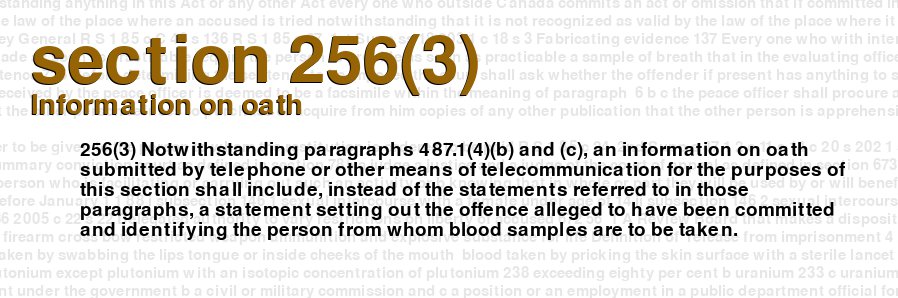
256(3) Notwithstanding paragraphs 487.1(4)(b) and (c), an information on oath submitted by telephone or other means of telecommunication for the purposes of this section shall include, instead of the statements referred to in those paragraphs, a statement setting out the offence alleged to have been committed and identifying the person from whom blood samples are to be taken.
Explanation
Section 256(3) of the Criminal Code of Canada pertains to the taking of blood samples for the purposes of alcohol and drug testing in relation to impaired driving offenses. The section allows for information to be submitted on oath by telephone or other means of telecommunication, as opposed to in person, in order to obtain a warrant for the collection of such samples.
This provision is particularly useful in situations where time is of the essence, such as when an individual suspected of impaired driving is in need of medical attention and cannot be transported to a police station to provide a breath or urine sample. By allowing for remote information to be submitted, the process can be expedited and potentially life-saving medical treatment can be provided without compromising the ability to collect vital evidence.
It is important to note that the information submitted must include a statement setting out the offense alleged to have been committed and identifying the person from whom blood samples are to be taken. Additionally, the use of this provision is not to be taken lightly, as it involves a search of the individual's body and may infringe upon their privacy and bodily integrity rights.
Ultimately, section 256(3) provides a necessary and practical mechanism for obtaining a warrant for the collection of blood samples in impaired driving cases where time is of the essence, while still upholding the rights of the individual being searched.
Commentary
Section 256(3) of the Criminal Code of Canada allows for the collection of blood samples from individuals suspected of impaired driving. This provision provides law enforcement with a powerful tool to combat one of the leading causes of traffic fatalities in Canada. However, it also raises important questions about the scope of police powers, and the rights and privacy of individuals.
The provision allows for an information on oath to be submitted by telephone or other means of telecommunication in order to obtain a warrant for the taking of blood samples. This means that police officers do not need to physically appear before a judge to obtain a warrant. Instead, they can apply by telephone, which is a much faster and more efficient process. However, this also means that the judge who issues the warrant will not have the opportunity to assess the credibility of the officer submitting the information or to ask questions about the case.
Moreover, Section 256(3) specifies that the information on oath submitted by telephone or other means of telecommunication must include a statement setting out the offence alleged to have been committed and identifying the person from whom blood samples are to be taken. This means that there must be reasonable grounds to believe that the individual has committed an offence before a warrant can be issued. However, this also raises questions about the threshold for obtaining a warrant, and whether or not the courts are overly deferential to police officers.
One potential concern with Section 256(3) is that it could be used as a pretext for racial profiling. If police officers are relying on this provision more frequently to obtain warrants for blood samples, then there is a risk that they will target certain communities or individuals more often than others. This could lead to a disproportionate impact on certain groups and undermine the trust that these communities have in the police.
Another concern is the potential for abusive use of this provision. If officers are able to obtain warrants much more easily and quickly, there is a risk that they will do so even when they do not have a reasonable belief that an offence has been committed. This could lead to violations of individuals' rights and undermine the legitimacy of the criminal justice system.
Despite these concerns, Section 256(3) can be a powerful tool for law enforcement in combatting impaired driving. The provision helps to ensure that individuals who are suspected of driving under the influence are able to be quickly and efficiently tested for impairment. This can help to deter others from driving while impaired, which in turn can help to reduce traffic fatalities and injuries.
Overall, Section 256(3) of the Criminal Code of Canada is a complex provision with both benefits and risks. While it provides law enforcement with an important tool to combat impaired driving, it also raises questions about the scope of police powers and the rights and privacy of individuals. Policymakers and lawmakers need to continue to monitor and evaluate the use of this provision to ensure that it is being used in a fair and just manner.
Strategy
Section 256(3) of the Criminal Code of Canada is a unique provision that allows a law enforcement officer to obtain a warrant for taking a suspect's blood samples without physically appearing before a Justice of the Peace. The section allows the officer to apply for a warrant by way of telecommunication means, such as telephone or email.
However, there are several strategic considerations to keep in mind when dealing with this section. Here are some considerations and strategies that could be employed:
1. Understanding the legal requirements: As with any other legal provision, it is essential to have a good understanding of the legal requirements prescribed in section 256(3). The person making the application for a warrant must be a peace officer, and the information on oath must identify the person from whom blood samples are to be taken and the alleged offence. Failure to meet these basic requirements could lead to the warrant being invalidated.
2. Accurate and detailed information: In applying for a warrant under section 256(3), the information provided must be accurate and detailed. The officer must ensure that all the necessary information is included in the application, such as the name of the suspect, his or her physical description, and the offence being investigated. Providing insufficient or inaccurate information may result in the warrant being invalidated.
3. Use of technology: Section 256(3) allows the use of technology such as email or telephone to apply for a warrant. This provision is particularly useful in situations where obtaining a warrant in person is not feasible or when time is a critical factor. However, when using technology, it is essential to ensure that the information provided is secure and cannot be intercepted or tampered with.
4. Compliance with Charter Rights: Any warrant obtained under section 256(3) must comply with the Charter of Rights and Freedoms. Evidence obtained in violation of Charter rights is inadmissible in court. Therefore, it is crucial to ensure that the warrant is legally obtained and that Charter rights are not violated.
5. Communication with the Justice of Peace: In some cases, the Justice of the Peace may require the peace officer to provide further information or evidence before issuing a warrant. It is essential to be prepared to answer any questions the Justice of the Peace may have and to provide any additional information requested.
In conclusion, section 256(3) of the Criminal Code of Canada provides a useful tool for law enforcement officers investigating offences that require blood samples. However, it is essential to consider the strategic considerations mentioned above and to ensure compliance with legal requirements, Charter rights, and communicate effectively with the Justice of the Peace when seeking a warrant under this section.