Editorial Annotation
Punishment
Introduction
Offences involving restricted/prohibited firearms or committed for the benefit of a criminal organization carry a maximum sentence of 14 years imprisonment and a minimum of 5 years (first offence) or 7 years (subsequent offence), while all other cases carry a maximum sentence of 14 years imprisonment and a minimum of 4 years.
Statutory Text
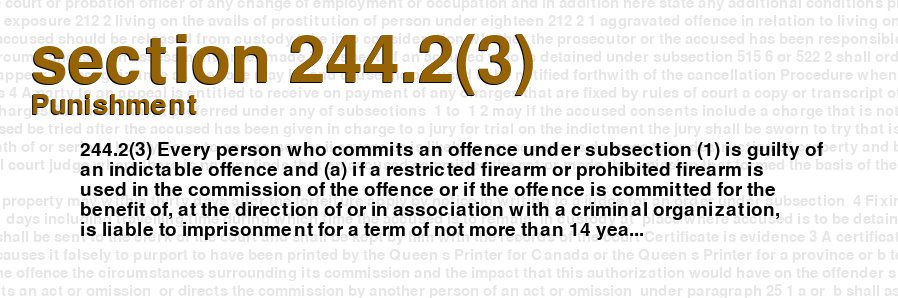
244.2(3) Every person who commits an offence under subsection (1) is guilty of an indictable offence and (a) if a restricted firearm or prohibited firearm is used in the commission of the offence or if the offence is committed for the benefit of, at the direction of or in association with a criminal organization, is liable to imprisonment for a term of not more than 14 years and to a minimum punishment of imprisonment for a term of (i) five years, in the case of a first offence, and (ii) seven years, in the case of a second or subsequent offence; and (b) in any other case, is liable to imprisonment for a term of not more than 14 years and to a minimum punishment of imprisonment for a term of four years.
Explanation
Section 244.2(3) of the Criminal Code of Canada deals with the offence of using a firearm in the commission of an offence. It states that anyone who commits such an offence is guilty of an indictable offence and is subject to imprisonment for a term of up to 14 years.
The section also distinguishes between two different types of firearm offences. If the offence is committed using a restricted or prohibited firearm, or for the benefit of a criminal organization, then the offender is subject to a minimum punishment of five years imprisonment for a first offence, and seven years for a subsequent offence. If the offence is not committed under those circumstances, then the minimum punishment is four years imprisonment.
The purpose of this section is to deter offenders from using firearms in the commission of crimes. The minimum punishments for first and subsequent offences are intended to reflect the seriousness of the offence, as well as the dangers associated with the use of firearms. By imposing severe penalties on those who use firearms to commit crime, the government hopes to reduce the prevalence of these types of offences.
Overall, section 244.2(3) is an important tool for law enforcement in addressing firearm-related crime. It serves to protect the public from those who would use firearms to cause harm, and sends a strong message that such behaviour will not be tolerated.
Commentary
Section 244.2(3) of the Criminal Code of Canada is a provision that outlines the punishment for individuals who commit offences under subsection (1) of the section. This provision is part of Canada's efforts to control and curb the proliferation of firearms, particularly restricted and prohibited firearms, which are considered dangerous and pose significant threats to public safety.
The legislation imposes severe penalties on individuals who use restricted or prohibited firearms in the commission of the offence or if the offence is committed for the benefit of, at the direction of or in association with a criminal organization. The punishment for these offences is a maximum of 14 years in prison, and a minimum sentence of five years for a first offence and seven years for a subsequent offence.
The rationale behind this provision is to send a clear message to those who may be tempted to use firearms to commit crimes. The mandatory minimum sentence of 5 or 7 years is intended to deter offenders from committing these types of offences, and the maximum sentence of 14 years is a reflection of the seriousness of the crime.
The provision is also designed to target individuals who may be involved in organized criminal activity. By increasing the penalties for offences committed in association with criminal organizations, the law seeks to disrupt and dismantle these groups, reduce the number of firearms circulating in the criminal underworld, and ultimately enhance public safety.
However, some critics of this provision argue that mandatory minimum sentences are not effective in reducing crime rates. They point to studies that show that mandatory minimums do not deter individuals from committing crimes, and that they can lead to unjust sentences, especially for marginalized and racialized communities.
Furthermore, critics argue that the provision may be too broad, as it does not distinguish between individuals who may have used a firearm in a justifiable situation, such as self-defence or defence of property, and those who have used firearms in commission of a crime. This may result in individuals who have acted in self-defence receiving unduly harsh sentences.
In conclusion, Section 244.2(3) of the Criminal Code of Canada is a provision that seeks to control the use of restricted and prohibited firearms in the commission of offences. The provision imposes severe penalties on individuals who use firearms to commit crimes and is intended to deter individuals from engaging in these types of offences. However, the use of mandatory minimum sentences may not be the most effective way to deter crime, and may lead to unjust sentences. It is crucial to find a balance between enhancing public safety and ensuring that justice is served fairly.
Strategy
Section 244.2(3) of the Criminal Code of Canada is a provision that deals with those who commit an offence under subsection (1) of this section. This offence relates to the illegal use, possession or sale of a firearm. The section lays down the possible punishments for those who are involved in such acts. The punishment varies according to the degree of the offence and whether a restricted or prohibited firearm is used in the commission of the offence.
Dealing with this section of the Criminal Code of Canada requires a good understanding of the law, knowledge of the defenses available, an experienced criminal lawyer, and sound strategies to help minimize the penalties imposed. The following are some of the strategic considerations when dealing with this section of the Criminal Code of Canada:
1. Understanding the Law: The Criminal Code of Canada is complex and ever-changing. A strong understanding of the section is therefore necessary to be able to build a good defense. An experienced criminal lawyer should be able to provide guidance on the section of the law and its criminal implications.
2. Factual analysis: It is important to conduct a factual analysis of the case to determine its strengths and weaknesses. This analysis should be aimed at finding out about pertinent details like how the offense was committed, the role of the offender, and any circumstances that either mitigate the offense or aggravate it.
3. Mitigation factors: The Criminal Code of Canada allows for some mitigation factors that could reduce the punishment for an offence. For instance, if any mitigating circumstance is found, the minimum sentence may not be imposed. This is why it's necessary to examine the case closely to determine all the mitigating factors before developing a strategy.
4. Bifurcated Trial Strategy: A bifurcated trial strategy is when the case is separated into two distinct parts, the guilt phase, and the sentencing phase. Adopting this strategy can be beneficial in some cases, especially when the prosecutor has a strong case. The defendant's lawyer can concede to the guilt of the defendant and then concentrate on the sentencing phase, where they present evidence and argument to mitigate the punishment.
5. Plea Bargaining: This strategy involves negotiating with the prosecutor to plead guilty to lesser charges in exchange for reduced sentencing. This approach is only wise when the evidence against the accused is compelling and there is no hope of securing an acquittal. In such cases, the defendant's lawyer can use plea bargaining to seek a more lenient punishment.
Overall, Section 244.2(3) of the Criminal Code of Canada is a stringent provision, and anyone facing charges under it must be aware of the serious consequences that accompany a finding of guilt. It is therefore important to seek the services of experienced legal counsel to help with the case, and to carefully develop a defense strategy that best suits the situation.