Editorial Annotation
Counselling or aiding suicide
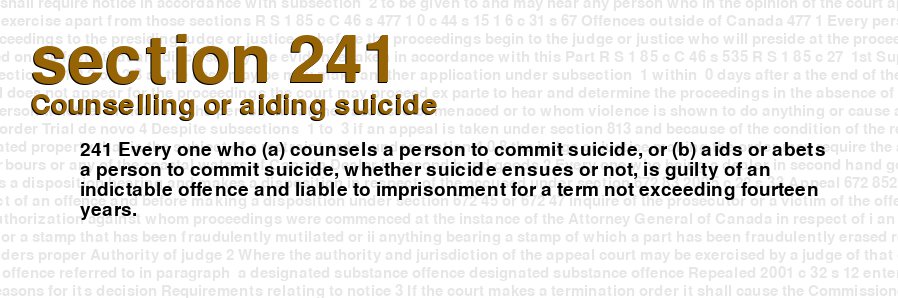
Introduction
Statutory Text
Explanation
Section 241 of the Criminal Code of Canada criminalizes two distinct acts related to suicide: counseling someone to commit suicide and aiding or abetting someone in committing suicide. These acts are considered to be morally reprehensible and against the fundamental value of preserving human life.
Counseling someone to commit suicide refers to actively encouraging or advising someone to take their own life. This includes providing information on how to commit suicide and the means to do so. Counseling can be done in person or through electronic communication, such as social media or emails.
Aiding or abetting someone in committing suicide refers to providing assistance, encouragement, or support to someone in the process of ending their own life. This can include providing the means for the suicide, such as a weapon or drugs, or even physically assisting the person in the act of suicide.
It is important to note that this section of the Criminal Code does not criminalize the act of committing suicide itself, but rather the actions of those who facilitate or encourage it. The punishment for these offenses can include up to 14 years in prison.
The rationale behind criminalizing these actions is to protect vulnerable individuals who may be contemplating suicide from being encouraged or coerced into taking their own life. It also sends a message that society values and prioritizes the preservation of human life.
Overall, section 241 of the Criminal Code of Canada serves as a deterrent against encouraging or assisting someone to commit suicide, and promotes a culture of respect for human life.
Commentary
Section 241 of the Criminal Code of Canada is a law that criminalizes both counseling and aiding a person to commit suicide. This section of the code has been a subject of intense debate among legal scholars, health professionals, and the public. While some argue that it violates an individual's right to autonomy and end-of-life choices, others posit that it is necessary to prevent vulnerable people from being coerced or manipulated into taking their own lives.
Suicide in Canada has been a long-standing issue, with approximately 3,000 deaths by suicide each year. In recent years, there has been a growing push for euthanasia or medically assisted suicide for individuals who may be suffering from terminal illnesses or debilitating chronic conditions. Section 241, however, makes it clear that counseling or aiding in suicide is a criminal offense and is punishable with imprisonment.
The law explicitly prohibits the act of counseling a person to commit suicide. This means that if an individual advises, encourages, or convinces someone to take their own life, they could be charged with a criminal offense. This provision is in place to deter people from pushing vulnerable individuals towards suicide. For instance, if an individual is feeling depressed, mentally unwell, or experiencing suicidal thoughts, counseling them to end their life could be seen as taking advantage of their emotional state to further one's own interests. Therefore, the law considers such behavior unacceptable and criminal.
In addition to counseling, Section 241 also criminalizes aiding or abetting a person to commit suicide. Aiding or abetting a person to commit suicide refers to any action intended to assist, facilitate, or participate in the act of taking one's life. This could include providing a suicidal individual with the means to end their life, such as a weapon or deadly substance, or actively participating in the act, such as physically helping the person end their life. In such cases, an individual could be charged with an indictable offense and could face up to fourteen years of imprisonment.
While some argue that these provisions restrict an individual's right to autonomy and end-of-life choices, the law is in place to prevent vulnerable people from falling victim to coercion and manipulation. Moreover, individuals who counsel and/or assist suicide may be driven by selfish motives, such as gaining access to the victim's estate or inheritance. Therefore, Section 241 acts as a deterrent to those who may seek to take advantage of vulnerable people by pressuring them to commit suicide.
In conclusion, Section 241 of the Criminal Code of Canada criminalizes both counseling and aiding a person to commit suicide. While this law restricts an individual's right to autonomy and end-of-life choices, it is necessary to prevent vulnerable people from being coerced or manipulated into taking their own lives. Therefore, it is essential to strike a balance between an individual's right to autonomy and the need to protect the vulnerable members of society.
Strategy
When dealing with section 241 of the Criminal Code of Canada, some strategic considerations include understanding the elements of the offence, the potential defences available, and the sentencing options. It is also important to consider the public perception of the offence and the potential impact it may have on the accused's reputation.
One strategy that could be employed in defending against a charge under section 241 is to argue that the accused did not have the requisite mens rea, or intent, to commit the offence. In order to be convicted under this section, the accused must have knowingly and intentionally counselled or aided in the suicide of another person. If the accused can demonstrate that they did not have this intent, it may be possible to avoid a conviction.
Another strategy that could be employed is to argue that the accused's actions were not a substantial cause of the suicide. This may be particularly relevant in cases where the victim had a pre-existing intent to commit suicide and the accused's actions merely facilitated this decision. By demonstrating that their actions were not a significant factor in the victim's decision, the accused may be able to avoid a conviction.
In cases where a conviction is likely, it may be possible to negotiate a plea deal with the Crown to mitigate the potential sentence. This could involve agreeing to plead guilty to a lesser offence or accepting a reduced sentence in exchange for cooperation with the investigation or other factors.
Finally, it is important to consider the impact of a conviction under section 241 on the accused's reputation and future prospects. This offence is viewed very negatively by the public and can have significant consequences for the accused in terms of employment, social standing, and other factors. As such, it may be necessary to consider how to mitigate the impact of a conviction on the accused's life moving forward.
Overall, dealing with section 241 of the Criminal Code of Canada requires careful consideration of the elements of the offence, potential defences, and sentencing options. By employing effective strategies and negotiating with the Crown, it may be possible to defend against a charge or minimize the consequences of a conviction.