Editorial Annotation
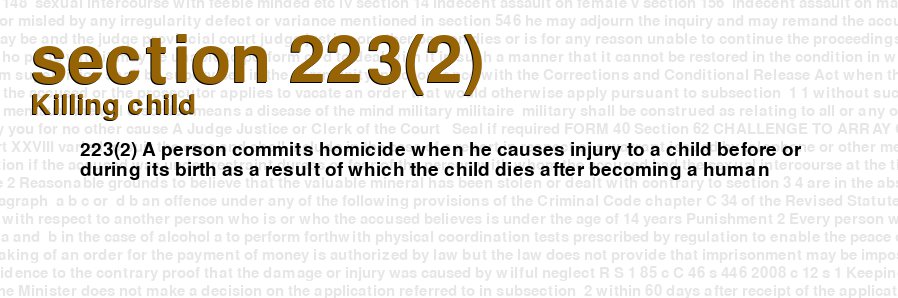
Killing child
Introduction
Statutory Text
Explanation
Section 223(2) of the Criminal Code of Canada defines homicide as the act of causing injury to a child, either before or during its birth, which results in the child's death after it becomes a human being. This provision criminalizes the act of causing injury to a fetus that is later born and dies as a result of that injury.
This provision is notably controversial as it touches on the highly debated topic of abortion. It establishes that a fetus or an unborn child can be considered a human being for the purposes of criminal law, but only once they are born alive. Therefore, it does not apply to an act of abortion or a woman's right to choose to terminate a pregnancy.
The section also provides for a number of defences should an individual be charged with homicide under these circumstances. These defences include the mother's consent, the medical necessity of the act, or the act being committed in good faith for the purpose of preserving the life of the mother.
Overall, section 223(2) is an essential provision in the Criminal Code that aims to provide clarity on when homicide can be considered to have occurred in cases where a child has been injured before or during birth and dies as a result. It ensures that individuals who commit such an act are held responsible for their actions and allows for appropriate legal consequences to be imposed.
Commentary
Section 223(2) of the Criminal Code of Canada is a controversial piece of legislation that has elicited a lot of debate and discussion in the country. This law criminalizes acts that lead to the death of an unborn child after it has become human as a result of injuries inflicted on the mother before or during birth. Essentially, it means that causing injury to a pregnant woman that results in the death of an unborn child is viewed as homicide, just like any other crime that causes someone's death.
This law has been subject to criticism from various groups, including pro-choice activists, women's rights campaigners, and medical professionals. The main argument against this law is that it infringes upon women's reproductive rights by making their behavior during pregnancy subject to criminal scrutiny. This means that a pregnant woman who engages in behavior that results in the death of her unborn child could be held criminally liable, even if she did not intend to cause such harm.
Moreover, some have argued that the law creates a potential conflict with the right to an abortion in Canada, which is guaranteed by the Charter of Rights and Freedoms. The law could be interpreted to mean that an attempted abortion that results in the death of a baby that has become a human being could be considered homicide under the law, leading to confusion and problematic enforcement.
However, proponents of the law argue that it is necessary to protect unborn children from harm and to ensure that those who cause harm to pregnant women are held accountable for their actions. Supporters contend that the law does not infringe on women's rights, as it only applies to situations where an individual intentionally causes harm to a pregnant woman and the unborn child dies as a result of that harm. It also ensures that those who cause harm to pregnant women, whether intentionally or accidentally, are brought to justice for their actions.
Medical professionals have also raised concerns about the practicalities of enforcing the law. The law requires that the child must have become "human" before its death, leaving the definition of what constitutes "human" open to interpretation. This could create difficulties for medical professionals tasked with determining the cause of death of a premature baby, as well as for legal authorities tasked with enforcing the law.
In conclusion, Section 223(2) of the Criminal Code of Canada remains a contentious issue, with differing opinions on its necessity, effectiveness, and potential for unintended consequences. While its proponents see it as a means of providing legal protection for unborn children and pregnant women, its critics view it as an infringement on women's rights and a potential source of confusion for the medical profession. As with any complex legal issue, the debate surrounding this law is unlikely to be resolved anytime soon.