Editorial Annotation
Exception
Introduction
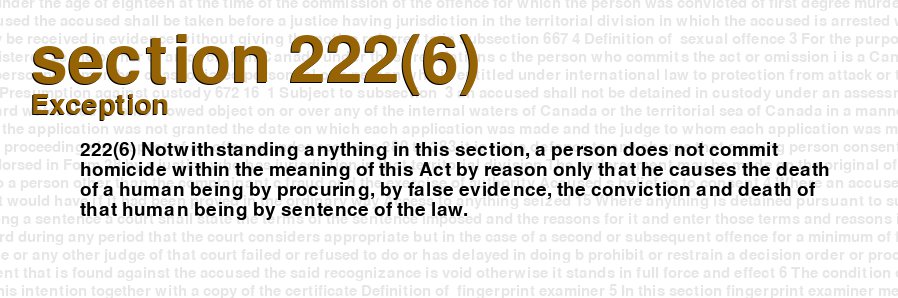
This section states that causing the death of someone through the false conviction and death sentence does not constitute homicide under the Criminal Code of Canada.
Statutory Text
Explanation
Section 222(6) of the Criminal Code of Canada provides a special provision that exempts an individual from being charged with homicide if they caused the death of a human being by procuring, through false evidence, a conviction and death sentence. This provision applies even if the individual was involved in the defendant's prosecution and provided false testimony during the trial.
In other words, if an individual knowingly provides false evidence that leads to the wrongful conviction and execution of an innocent person, they will not be deemed to have committed a homicide under the Canadian criminal justice system.
This provision offers a unique protection against wrongful convictions and the possibility of innocent individuals being unfairly executed. It recognizes that the individual involved in the wrongful conviction and sentencing may not have had the intention to cause harm, but rather acted out of personal or external pressures.
Despite the beneficial intent behind this section, it remains a contentious issue for some who argue that it offers a potential loophole for those who intentionally provide false evidence to manipulate the legal system for their own gain.
Overall, section 222(6) serves as a statutory protection against wrongful convictions and is a reflection of Canada's commitment to upholding its jurisdiction's legal integrity.
Commentary
Section 222(6) of the Criminal Code of Canada is a highly debated and controversial provision. It provides that a person does not commit homicide by reason only that he causes the death of a human being by procuring, by false evidence, the conviction and death of that human being by sentence of the law. In effect, it legalizes the killing of a person who has been falsely convicted of a crime and sentenced to death as a result of fabricated evidence.
This provision has been criticized by many, including human rights organizations, as being inconsistent with Canada's commitments to human rights, justice, and the rule of law. It has been argued that it encourages the use of fabricated evidence by police officers and prosecutors and undermines the integrity of the criminal justice system.
One of the major concerns with this provision is that it gives a free pass to those who engage in the fabrication of evidence in order to secure a conviction and sentence of death. This not only undermines the fundamental principles of the justice system but also opens a door to abuse of power by those entrusted with the responsibility of maintaining law and order.
Another concern is that this provision disproportionately impacts certain vulnerable communities, such as Indigenous peoples and people of colour, who have historically been subject to systemic discrimination and racial biases in the criminal justice system. Innocent people from these communities are more likely to be falsely convicted due to systemic biases and failures in the justice system, and this provision makes it easier for those responsible for their wrongful conviction to avoid punishment.
Moreover, this provision is at odds with international human rights standards, including the Universal Declaration of Human Rights and the International Covenant on Civil and Political Rights, which both prohibit the use of the death penalty and safeguard the right to a fair trial.
In conclusion, Section 222(6) of the Criminal Code of Canada has been a source of controversy and debate for many years. Its legality is a clear example of how laws and policies can have far-reaching implications beyond their initial intent and objectives. It is high time for the Canadian government to review this provision and repeal it to ensure that Canada upholds its commitment to human rights, justice, and the rule of law.
Strategy
Section 222(6) of the Criminal Code of Canada provides legal immunity to individuals who cause the death of another person by procuring their conviction and death sentence through false evidence. This provision presents several strategic considerations when dealing with criminal cases that involve false evidence.
Firstly, defense lawyers may consider using this provision to protect their clients who are implicated in cases of false evidence. They can argue that their clients did not commit homicide within the meaning of the Act, and thus should not be convicted of murder. This strategy involves proving that the defense client did not actively cause the death of the victim, but rather that the victim's death resulted from a miscarriage of justice caused by the false evidence. However, defense lawyers must be cautious when using this strategy as it can be difficult to prove that the evidence used in the original trial was false, and that the client was aware of its falsity.
Secondly, prosecutors should be mindful of this provision when prosecuting cases that involve false evidence. They must ensure that the evidence they present in court is credible and accurate. The prosecution must also prove beyond a reasonable doubt that the suspect actively caused the victim's death, and that the death sentence was not a result of false evidence.
Thirdly, judges presiding over cases involving false evidence must consider section 222(6) when handing down judgments. They must ensure that the evidence presented in court is credible, and that the suspect's actions directly caused the victim's death. Judges must also consider the reliability of the evidence presented in the original trial and any new evidence presented in the current trial.
One possible strategy that could be employed by prosecutors and defense lawyers is to use forensic evidence to determine the actual cause of death. Forensic evidence such as DNA, fingerprints, and ballistics can provide reliable evidence that can help prove or disprove the suspect's involvement in the death of the victim. This strategy can be effective in cases where false evidence was used to convict the suspect.
In addition, it may be helpful to engage the services of expert witnesses who can provide objective analysis and interpretation of the evidence presented in court. Expert witnesses can be instrumental in proving or disproving the prosecution's case or the defense's case.
Furthermore, it may be necessary to conduct a thorough investigation to establish the facts of the case and determine the extent of the false evidence used to procure the conviction and death sentence of the victim. This investigation may involve gathering new evidence and revisiting old evidence presented during the original trial.
In conclusion, section 222(6) of the Criminal Code of Canada presents several strategic considerations when dealing with criminal cases involving false evidence. Prosecutors and defense lawyers must carefully consider the evidence presented in court, engage expert witnesses, and conduct thorough investigations to establish the facts of the case. By using these strategies, justice can be served, and wrongful convictions can be avoided.