Editorial Annotation
Duty of persons undertaking acts dangerous to life
Introduction
Statutory Text
Explanation
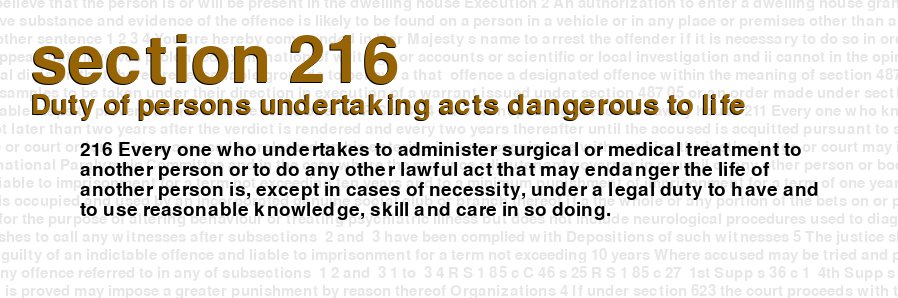
Section 216 of the Criminal Code of Canada imposes a legal duty on individuals to exercise reasonable care, skill, and knowledge when administering medical treatment or performing any lawful act that may endanger the life of another person. This section applies to anyone who undertakes to provide medical care, whether they are trained medical professionals or individuals without formal medical training.
The ultimate aim of this section is to ensure the safety and well-being of patients. It recognizes that medical procedures and treatments inherently involve some level of risk, and therefore, those who undertake such actions are responsible for ensuring that they take all reasonable precautions to minimize such risks.
Under section 216, individuals who perform medical procedures or treatments must have the necessary knowledge and skills to carry out their duties competently. They are also required to use appropriate care and caution while performing medical procedures or treatments to minimize the risks to the patient. Any failure to exercise reasonable care, skill, or knowledge could result in legal liability for the individual responsible.
However, the section also recognizes that there may be situations where medical treatment is necessary to protect the life of a patient, even if the person administering the treatment may not have the necessary skills and knowledge. In such situations, the law recognizes the doctrine of necessity, which allows individuals to perform medical procedures or treatments in good faith, despite lacking formal training or experience.
Overall, section 216 of the Criminal Code of Canada aims to promote responsible medical care that prioritizes the safety and well-being of patients while also recognizing the need for individuals to act in good faith in certain situations. It is an essential provision that establishes a clear legal standard for those who undertake to provide medical care in Canada.
Commentary
Section 216 of the Criminal Code of Canada imposes a legal duty upon medical practitioners to have and use reasonable knowledge, skill, and care when administering surgical or medical treatment to another person, or doing any other lawful act that may endanger the life of another person. The purpose of this section is to ensure that medical practitioners adhere to an acceptable standard of care, thereby safeguarding the lives of patients.
The section is critical in Canadian jurisprudence as it holds medical practitioners accountable for their actions, and provides a legal framework for victims of medical malpractice to seek justice. It has proven to be an effective deterrent against medical negligence by providing a clear message to medical practitioners that deviating from the expected standard of care when treating patients will result in legal consequences.
Under Section 216, the legal duty that medical practitioners must adhere to is "reasonable knowledge, skill, and care." This duty is subjective and requires the courts to assess what is reasonable in a particular case. In assessing the reasonableness of a medical practitioner's actions, the courts take into account the specific facts and circumstances of the case, including the level of complexity of the treatment, the standard of care expected of a competent practitioner, and the type of medical condition being treated.
The legal duty prescribed in Section 216 is not absolute; there are exceptions when medical practitioners may deviate from the expected standard of care. When medical practitioners are faced with an emergency, they are allowed to act without following the standard of care. In such cases, the practitioners are only required to act in good faith, using their knowledge, skills, and expertise to save the patient's life. Other exceptions include circumstances where the patient has given informed consent to a procedure or treatment.
One of the challenges in enforcing Section 216 is determining what constitutes reasonable knowledge, skill, and care in a particular medical practice, as the level of care expected varies depending on the nature of the profession being practised. For instance, while the standard of care expected of a family physician may differ from that expected of a surgeon, the two professions share the same legal duty to provide reasonable knowledge, skill, and care.
In conclusion, Section 216 of the Criminal Code of Canada serves as a legal tool for ensuring that medical practitioners adhere to the expected standard of care in their practice, which is essential in protecting the lives of patients. By imposing a legal duty on medical practitioners to provide "reasonable knowledge, skill, and care" when administering treatment or doing any other lawful act that may endanger lives, the section provides clarity and accountability in medical practice. However, while the section provides a legal framework in protecting patients in medical settings, there is a continuous need to educate medical professionals on the extent of their legal obligation and the importance of providing the highest level of care to their patients.
Strategy
Section 216 of the Criminal Code of Canada is a provision that outlines the legal duty of individuals who undertake the administration of surgical or medical treatment, or any other lawful act that may endanger the life of another person. This provision highlights the importance of using reasonable knowledge, skill, and care when performing any medical procedure. Failing to comply with this duty may result in criminal charges or civil liability.
For healthcare professionals, compliance with Section 216 is essential as it not only ensures patient safety but also protects them from legal action. Therefore, healthcare providers need to consider the following strategic considerations when dealing with this provision.
Firstly, healthcare professionals need to ensure that they have the appropriate knowledge, skills, and training to undertake any medical procedure or treatment. This implies that before performing any procedure, healthcare providers should assess their level of competence and qualifications. This strategic consideration ensures that healthcare providers do not put patients' lives at risk due to a lack of knowledge or expertise.
Secondly, healthcare professionals should obtain informed consent from their patients before any medical treatment. Informed consent implies that healthcare providers should explain the potential risks and benefits of the medical procedure to the patient. This strategic consideration ensures that patients are aware of the potential risks of the procedure and can make informed decisions about their treatment.
Thirdly, healthcare professionals should document all medical procedures they undertake. Documentation should include the patient's medical history, informed consent forms, and any other relevant medical information. This strategic consideration ensures that healthcare providers can provide evidence of their compliance with Section 216 if needed.
Fourthly, healthcare professionals should ensure that they have malpractice insurance coverage. Malpractice insurance protects healthcare providers from liability in the event of a legal action related to medical malpractice. This strategic consideration ensures that healthcare providers can provide compensation to patients in the event of medical negligence.
Lastly, healthcare professionals should ensure that they maintain their professional obligations to patients. This includes keeping up-to-date with the latest medical developments and advances, being honest and transparent with patients, and providing high-quality medical care. By adhering to professional obligations, healthcare providers can improve patient outcomes and reduce the risk of legal action.
In summary, compliance with Section 216 of the Criminal Code of Canada is crucial for healthcare providers. Strategic considerations such as ensuring appropriate qualifications and knowledge, obtaining informed consent, documentation, malpractice insurance coverage, and professional obligations can help healthcare providers to comply with this provision. Compliance with Section 216 not only improves patient safety but also protects healthcare providers from legal action.