Editorial Annotation
Definition of international cruise ship
Introduction
This section defines international cruise ship as a passenger ship suitable for ocean voyages of at least 48 hours, but excludes those primarily used for transporting cargo or vehicles.
Statutory Text
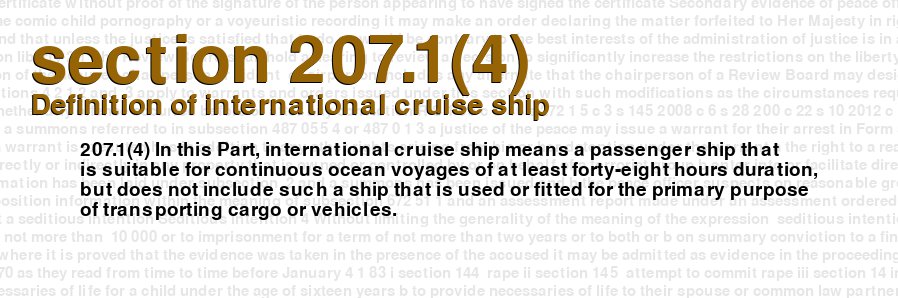
207.1(4) In this Part, "international cruise ship" means a passenger ship that is suitable for continuous ocean voyages of at least forty-eight hours duration, but does not include such a ship that is used or fitted for the primary purpose of transporting cargo or vehicles.
Explanation
Section 207.1(4) is part of the Criminal Code of Canada which defines certain terms applicable to Part VI of the Code, namely offences related to human trafficking. The section defines the term international cruise ship" for the purpose of those offences. An international cruise ship" under this section means a passenger ship that is capable of continuous ocean voyages of at least 48 hours duration, but is not used primarily for transporting cargo or vehicles.
The definition is important in the context of criminalizing human trafficking offences because it specifies the type of vessel that falls under the provisions of these offences. Trafficking of humans on an international cruise ship would be covered by this definition, whereas trafficking on other types of vessels, such as cargo ships, would not be covered.
This definition also helps to differentiate between an international cruise ship that is used for passengers and those that are only used for cargo or transportation of vehicles. This helps to ensure that the provisions are not applied to ships that are not primarily used for carrying passengers.
Overall, the purpose of this section is to provide clarity on what constitutes an international cruise ship" for the purpose of human trafficking offences. The specific definition is important in the context of prosecuting offenders who engage in human trafficking on such vessels, and in ensuring that the correct type of vessel is identified for the purposes of the criminal law.
Commentary
The Criminal Code of Canada is a set of laws that outlines criminal offences and their corresponding penalties. The section 207.1(4) of the Criminal Code of Canada defines the term "international cruise ship", which is used in Part XI.1 of the Criminal Code. This part deals with offences involving international maritime voyages, including piracy, hostage-taking, and terrorism.
According to this section of the Criminal Code of Canada, an international cruise ship is a passenger ship that is designed and equipped for continuous ocean voyages of at least forty-eight hours duration. The definition also notes that the ship should not be primarily used for transporting cargo or vehicles.
The definition of an international cruise ship is significant because it helps to differentiate between different types of vessels that operate on international waters. Passenger ships, such as international cruise ships, are generally subject to more stringent regulations and security measures due to the potential risks involved in carrying large numbers of people across international waters.
The distinction between passenger ships and cargo vessels is also important because it helps law enforcement agencies to determine the appropriate response in the event of an incident involving an international cruise ship. For example, in the case of piracy or terrorist threats, the response for a passenger ship would be different from that of a cargo vessel, as the risks and potential consequences are different for each.
Overall, the definition of an international cruise ship provided in section 207.1(4) of the Criminal Code of Canada is an important legal provision that can be used to mitigate risks and ensure the safety of passengers on international voyages. By defining the characteristics of an international cruise ship, law enforcement authorities can effectively respond to potential threats and ensure that those who engage in criminal activity on international waters are held accountable.
Strategy
Section 207.1(4) of the Criminal Code of Canada deals with international cruise ships and defines them as passenger ships used for continuous ocean voyages of a minimum of 48 hours, but not those used primarily for the transportation of cargo or vehicles. There are several strategic considerations to be made when dealing with this section of the Criminal Code of Canada.
The first strategic consideration is the safety and security of passengers on international cruise ships. Due to the nature of international cruise ships, they are often targeted by criminals looking to engage in criminal activities such as smuggling, money laundering, and terrorism. Therefore, effective security measures must be put in place to ensure the safety of passengers on these ships. These measures should include screening of passengers and their luggage, surveillance systems, trained security staff, and effective communication systems.
Another strategic consideration is compliance with international regulations. International cruise ships operate in various countries, each with its own set of regulations and standards. Therefore, these ships must comply with the regulations and standards of each country they visit. Failure to comply with these regulations could lead to legal and financial consequences such as fines and lawsuits.
A third strategic consideration is environmental conservation. International cruise ships can have significant impacts on the environment, such as air and water pollution and damage to marine ecosystems. Therefore, effective environmental management measures must be in place to mitigate these impacts. These measures should include the use of cleaner fuels, waste management systems, and responsible tourism practices.
Strategies that could be employed to address these strategic considerations include:
1. Implementing effective security measures. This involves hiring and training competent security staff, installing advanced surveillance systems, developing effective communication systems, and conducting regular security drills.
2. Complying with international regulations. This involves staying up-to-date with international regulations and standards, ensuring that all necessary permits and licenses are obtained, and implementing appropriate measures to comply with these regulations.
3. Implementing effective environmental management measures. This involves reducing the environmental footprint of international cruise ships by using cleaner fuels, implementing waste management systems, and promoting responsible tourism practices.
4. Building strong partnerships and collaborations. This involves working closely with other relevant stakeholders such as government agencies, environmental groups, and industry associations to develop and implement effective strategies for addressing the strategic considerations.
In conclusion, Section 207.1(4) of the Criminal Code of Canada defines international cruise ships as passenger ships used for continuous ocean voyages of a minimum of 48 hours. Strategic considerations when dealing with this section include the safety and security of passengers, compliance with international regulations, and environmental conservation. Strategies that could be employed include implementing effective security measures, complying with international regulations, implementing effective environmental management measures, and building strong partnerships and collaborations.