Editorial Annotation
Definition of offence
Introduction
Section 183(i) defines offence as any conspiracy, attempt, accessory after the fact, or counselling related to certain provisions of the Immigration and Refugee Protection Act.
Statutory Text
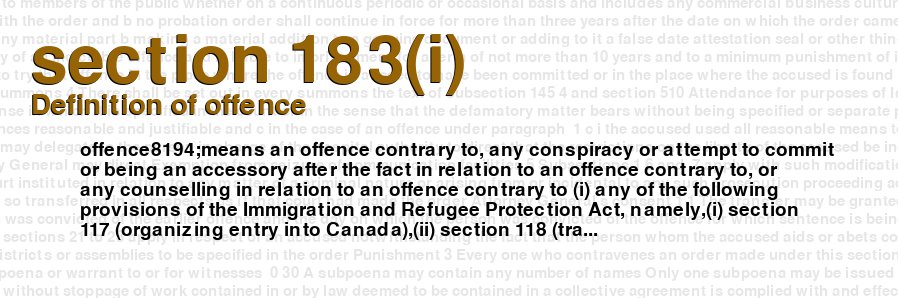
offence means an offence contrary to, any conspiracy or attempt to commit or being an accessory after the fact in relation to an offence contrary to, or any counselling in relation to an offence contrary to (i) any of the following provisions of the Immigration and Refugee Protection Act, namely,
(i) section 117 (organizing entry into Canada),
(ii) section 118 (trafficking in persons),
(iii) section 119 (disembarking persons at sea),
(iv) section 122 (offences related to documents),
(v) section 126 (counselling misrepresentation), or
(vi) section 129 (offences relating to officers),
Explanation
Section 183(i) of the Criminal Code of Canada identifies certain provisions of the Immigration and Refugee Protection Act as offences that can be prosecuted under the Criminal Code. Specifically, it includes organizing entry into Canada, trafficking in persons, disembarking persons at sea, offences related to documents, counselling misrepresentation, and offences relating to officers. This means that any person who is involved in a conspiracy or attempt to commit any of these offences, or who acts as an accessory after the fact, can be charged and convicted under the Criminal Code.
The inclusion of these provisions in Section 183(i) reflects Canada's commitment to combatting human trafficking and other forms of organized crime related to immigration. It also sends a strong message that these offences are taken seriously and will be prosecuted to the fullest extent of the law. Additionally, this section provides a powerful tool for law enforcement agencies to investigate and prosecute those who engage in these criminal activities, thereby protecting vulnerable individuals and preserving the integrity of Canada's immigration system. Overall, Section 183(i) serves as an important reminder that Canada does not tolerate illegal immigration or exploitation of vulnerable people.
Commentary
Section 183(i) of the Criminal Code of Canada encompasses a wide range of offences related to Canadian immigration laws. This provision aims to deter individuals from conspiring, attempting, or aiding in the commission of immigration-related offences. Moreover, it criminalizes counselling, which is the act of advising or persuading someone to engage in such prohibited activities.
The section specifically refers to six provisions of the Immigration and Refugee Protection Act (IRPA) that are considered to be grave crimes. These include organizing the illegal entry of persons into Canada (section 117), trafficking in persons (section 118), disembarking persons at sea (section 119), offences related to documents (section 122), counseling misrepresentation (section 126), and offences relating to officers (section 129).
Organizing the entry of persons into Canada is a serious offense because it contributes to human smuggling, which often involves exploitation, extortion, and endangerment of human lives. Trafficking in persons, on the other hand, involves the recruitment, transportation, and exploitation of vulnerable individuals, often for sexual or labor exploitation. Disembarking persons at sea pertains to the unauthorized transportation of individuals to Canada by sea and can pose a risk to national security. Offences related to documents entails falsifying or tampering with official Canadian documents, which can have far-reaching consequences for national security. Counseling misrepresentation involves advising or inducing someone to provide false information or to make false representations to Canadian authorities. Finally, offences relating to officers involve bribery, intimidation, or obstruction of immigration officials, thereby undermining the integrity of Canada's immigration system.
One of the significant implications of this section is that it holds not only the principal offenders but also those who aid or abet them liable for prosecution. This provision makes it challenging for individuals to escape legal consequences by being an accessory to unlawful acts. It also takes into account the fact that criminal organizations often have many people performing a variety of roles, and all those who contribute to the illegal activity must be held accountable.
Moreover, counseling is regarded as a serious offence under this provision, which is important because it recognizes that the advice and guidance of persons in power can significantly influence the actions of those who are misled or vulnerable. Counselors, who provide advice to potential immigrants on how to circumvent Canadian immigration laws, exploit their customers by providing false hope and can significantly contribute to criminal activity.
Overall, section 183(i) is a proactive measure by the Canadian government to prevent, discourage, and punish criminal organizations and individuals engaged in criminal activity related to immigration. The provision sends a clear message that Canada takes its immigration laws seriously and will not tolerate any attempts to undermine them. It underlines the need for all individuals to respect the laws of the country and demonstrates the Canadian government's commitment to safeguarding the security and integrity of the immigration system.
Strategy
Section 183(i) of the Criminal Code of Canada is an important provision as it makes certain offences under the Immigration and Refugee Protection Act (IRPA) criminal offences. Some of the strategic considerations that should be taken into account while dealing with this section are:
1. Understanding the Offences under IRPA: One of the first steps in developing a strategy to handle offences under Section 183(i) is to understand the offences under IRPA that have been listed under the section. For example, a person who violates section 117 of IRPA by organizing entry into Canada can be charged for offence under Section 183(i). A clear understanding of these offences and their implications will assist in crafting an effective defense.
2. Early Detection and Prevention: It is also important to develop strategies to detect and prevent offences under Section 183(i). This could involve creating an effective compliance program that emphasizes the importance of adhering to IRPA regulations, and training staff to identify signs of potential violations.
3. Responding to Allegations: If an allegation of an offence under Section 183(i) is made, it is critical to respond effectively. This could involve conducting an internal investigation to gather evidence and assess the situation. It is important to engage legal counsel early in this process as they can provide guidance on how to proceed.
4. Developing a Defense: Once an allegation of a Section 183(i) offence has been made and the evidence is gathered, developing a defense strategy becomes essential. This could involve challenging the evidence presented, contesting the charges laid, and highlighting any mitigating factors that may reduce the severity of the charges.
5. Negotiating a Plea Bargain: In cases where the evidence against the accused is strong, negotiating a plea bargain may be the best strategy. This could involve negotiating a reduced sentence in exchange for a guilty plea or cooperating with the authorities.
In conclusion, Section 183(i) of the Criminal Code of Canada is a serious provision that requires careful consideration and strategic planning. Strategies that focus on prevention, early detection, effective responses, developing a defense, and negotiation of a plea bargain can all be effective in managing the risks and the possible consequences of an offence under this section.