Editorial Annotation
Definition of offence
Introduction
Section 183(f) defines an offence as any conspiracy, attempt, or accessory after the fact related to false statements or smuggling under the Customs Act.
Statutory Text
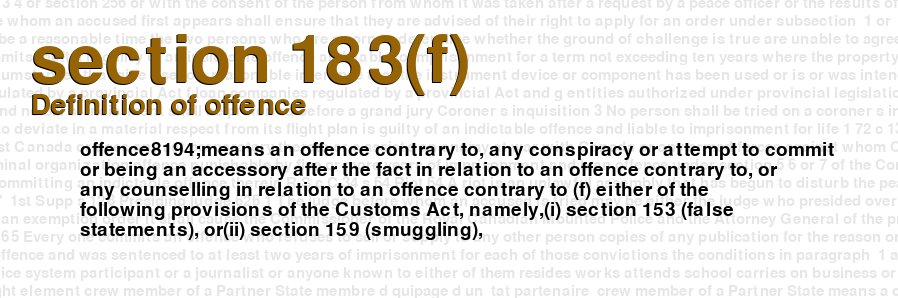
offence means an offence contrary to, any conspiracy or attempt to commit or being an accessory after the fact in relation to an offence contrary to, or any counselling in relation to an offence contrary to (f) either of the following provisions of the Customs Act, namely,
(i) section 153 (false statements), or
(ii) section 159 (smuggling),
Explanation
Section 183(f) of the Criminal Code of Canada deals specifically with offences related to false statements and smuggling in the Customs Act. This section makes it an offence to be involved in any conspiracy, attempt, or act as an accessory after the fact in relation to this type of offence. Additionally, counsel regarding an offence is also disallowed.
This section carries significant penalties for those found guilty, including heavy fines and even time in prison. These penalties are in place to deter individuals from breaking the law in this way and to help protect the integrity of the Canadian Customs regime.
The Customs Act is an essential piece of legislation in Canada as it governs the import and export of goods, the collection of trade statistics, and the protection of Canadian citizens from harmful materials. By creating an offence related to false statements and smuggling, the Criminal Code acts as a deterrent for those who might try to take advantage of loopholes in the customs process, thus fulfilling the critical role of the criminal justice system in protecting the public good.
In conclusion, section 183(f) of the Criminal Code plays a vital role in enforcing the Customs Act and protecting Canadian citizens. It acts as a warning to those who would attempt to circumvent the law and makes it clear that there will be consequences for those who do. By doing so, Canada can help ensure the integrity of its customs regime and protect its citizens from potential harm.
Commentary
Section 183(f) of the Criminal Code of Canada deals with offences related to Customs Act, specifically false statements and smuggling. This section is an important part of Canadian criminal law as it aims to control and regulate the import and export of goods and services across the Canadian border.
The first act mentioned under this section is making false statements. This offence refers to providing incorrect or misleading information to the authorities regarding an import or export. This type of information could relate to the description or value of the goods being imported or exported. False statements can be used to avoid customs duties or taxes, or to deceive authorities about the nature of the goods being imported or exported.
The second offence mentioned is smuggling. This offence refers to the act of bringing goods into Canada illegally or without proper authorization. This can include prohibited goods such as drugs or weapons, but also more innocuous goods such as cigarettes or alcohol that are being brought into the country without paying the proper duties or taxes.
One important thing to note is that the offence under section 183(f) of the Criminal Code does not require that an accused person must have personally committed the underlying offence. Rather, a person can be charged with an offence simply for being an accessory after the fact, for conspiring to commit the underlying offence, or for counselling someone else to commit it.
It is easy to understand why section 183(f) of the Criminal Code is important in Canada. The country has a thriving economy that is deeply tied to international trade. To protect this economy, the Canadian government must regulate and monitor the import and export of goods to ensure that the country's interests are protected. Customs authorities require accurate information to assess the proper duty and taxes to be charged on the goods being imported and exported. False information not only harms the Canadian government's ability to levy these taxes and duties but also opens up the possibility of illegal activities such as money laundering and trafficking.
In conclusion, Section 183(f) of the Criminal Code of Canada provides a legal framework for prosecuting those who commit offences related to the Customs Act. The act of smuggling and making false statements are serious crimes that can have a detrimental effect on Canada's economy and security. The section serves as a deterrent for those who may attempt to engage in such activities and ensures that those who do engage in them are held accountable for their actions. It is therefore an important part of the Canadian criminal legislation.
Strategy
Section 183(f) of the Criminal Code of Canada is an important legal provision intended to deter criminal activities surrounding false statements, smuggling, and other related offences under the Customs Act. As such, there are various strategic considerations that lawyers, prosecutors, and defendants need to keep in mind when dealing with this section of the Criminal Code. Some of these strategies include the following.
First, lawyers representing defendants charged with the offences enumerated in section 183(f) need to understand the legal requirements and the elements of each offence to build a robust defence strategy. For instance, if a defendant is charged with being an accessory after the fact in relation to an offence contrary to section 153 of the Customs Act, the lawyer will need to determine whether the defendant had the necessary mens rea to facilitate or conceal the commission of the offence. Similarly, if a defendant is charged with a conspiracy to smuggle goods into the country, the lawyer will need to investigate whether there was an agreement between the defendant and other co-accused to commit the offence.
Second, prosecutors need to have strong evidence to prove each element of the offences enumerated in section 183(f) to secure a conviction. This requires careful planning, investigation, and gathering of evidence. In many cases, prosecutors may need to rely on the testimony of accomplices, co-conspirators, or eyewitnesses to establish the chain of events leading to the commission of the offence. They may also use forensic evidence, such as DNA or fingerprints, to link the defendant to the crime scene.
Third, defendants may use plea bargaining to reduce their sentences or avoid convictions altogether. Plea bargaining involves bargaining or negotiating with prosecutors to plead guilty to lesser charges or receive a reduced sentence in exchange for cooperation with the authorities or other benefits. This strategy can be effective if the evidence against the defendant is strong, and the defendant wants to avoid the risks of a lengthy trial.
Fourth, defendants may use a defence strategy of challenging the admissibility of evidence or arguing that their rights were violated during the investigation or arrest. For instance, if the police obtained evidence illegally or through coercion, the defence lawyer may argue for the exclusion of such evidence from the trial. Similarly, if the defendant's rights were violated during the arrest, such as through the use of excessive force or lack of due process, the defence may seek to have the charges dismissed.
In conclusion, dealing with section 183(f) of the Criminal Code of Canada requires careful planning, strategy, and legal expertise. Lawyers, prosecutors, and defendants need to understand the legal requirements and the elements of each offence, the available evidence, and the possible defence strategies to secure a fair trial and protect their interests. The use of plea bargaining, challenging the admissibility of evidence, and robust defence strategies are some of the strategies that can be employed effectively in dealing with this legal provision.