Editorial Annotation
Definition
Introduction
Statutory Text
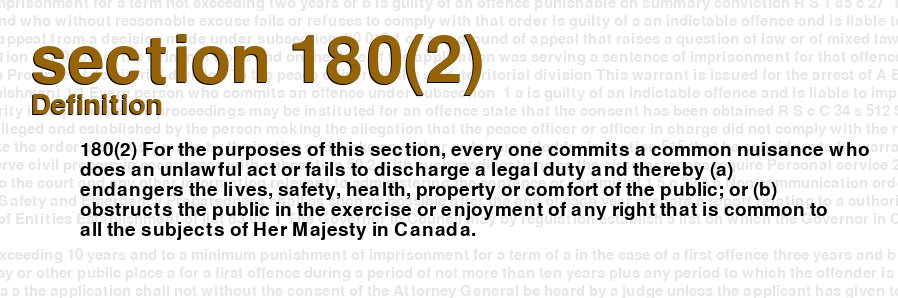
180(2) For the purposes of this section, every one commits a common nuisance who does an unlawful act or fails to discharge a legal duty and thereby (a) endangers the lives, safety, health, property or comfort of the public; or (b) obstructs the public in the exercise or enjoyment of any right that is common to all the subjects of Her Majesty in Canada.
Explanation
Section 180(2) of the Criminal Code of Canada is a provision dealing with the offence of common nuisance. It defines common nuisance as a situation where an individual commits an unlawful act or fails to discharge a legal duty, thereby endangering the lives, safety, health, property, or comfort of the public or obstructing their exercise or enjoyment of a common right.
This provision is aimed at preventing people from engaging in activities that can have a harmful impact on society. For instance, a person who sets up a loud and rowdy party in a residential area, disturbing the peace and tranquillity of the neighbourhood, can be charged with common nuisance. Similarly, a company that fails to take adequate measures to prevent environmental pollution or hazardous waste can also be charged under this section.
The offence of common nuisance is considered a summary conviction offence, meaning that it is less serious than an indictable offence but more serious than a regulatory offence. The maximum penalty for this offence is two years' imprisonment or a fine of up to $5,000, or both.
In conclusion, Section 180(2) of the Criminal Code of Canada is an important provision that helps to ensure that individuals or entities are held accountable for actions that can have a detrimental effect on society. It serves as a deterrent to those who may engage in activities that can cause harm or inconvenience to the public, and promotes public safety and well-being.
Commentary
Section 180(2) of the Criminal Code of Canada brings into focus the concept of common nuisance, outlining that it is an offense for individuals to engage in activities that endanger the public by obstructing their right to exercise or enjoy a common right, or failing to discharge legal duties. This section essentially highlights the importance of individual responsibility, stressing the significance of people's conduct and the impact it has on the society as a whole.
The section underlines that an individual can commit a common nuisance in two distinct ways. First, by engaging in an unlawful act that can endanger the public's lives, safety, health, property, or comfort. Second, by not fulfilling a legal obligation that could lead to obstruction in the public's exercise or enjoyment of their common rights.
The first scenario covers a broad range of unlawful activities that can cause harm to the society, including but not limited to, selling of illegal drugs, reckless driving, and public intoxication. These activities can be classified as common nuisances, posing a threat to public safety and health. When individuals engage in such activities, they are essentially selfishly pursuing their own interests while disregarding the well-being of the society. As such, section 180(2) seeks to address such irresponsible conduct, criminalizing it to deter potential offenders from engaging in these activities.
The second scenario deals with legal duties that individuals have to fulfill to ensure the public can exercise their common rights without any hindrance. These legal duties may arise from different fields, including construction, road safety, and public health. This part of the section highlights the importance of being responsible when undertaking activities that can affect the public's ability to enjoy their rights. For instance, construction firms have an obligation to ensure that their activities do not obstruct public routes or cause undue noise disturbance. Failure to fulfill these legal duties can be categorized as a common nuisance, punishable under the Criminal Code.
Overall, section 180(2) is essential in ensuring that individuals take responsibility for their actions and play a role in maintaining a safe and enjoyable environment for everyone. Through this section, the government sets a standard for individual conduct, highlighting the importance of considering the consequences of one's actions on the society as a whole. The section plays a vital role in deterring undesirable behavior that endangers public safety and infringes on the public's rights. In this vein, section 180(2) acts as a crucial tool in preserving the fundamental principles that govern Canadian society.
Strategy
When dealing with Section 180(2) of the Criminal Code of Canada, there are several strategic considerations that must be kept in mind. The first consideration is the scope of the section. It covers both acts of commission and acts of omission. Additionally, the section applies where there is endangerment of the public, or an obstruction of public rights that are common to all subjects of Her Majesty in Canada.
To address this section, one possible strategy is to explore the relevance of each component of the section. To establish that an act constitutes a common nuisance, it is first necessary to identify the act or omission in question, whether it is legal or illegal, and if there is any legal duty to discharge.
Regarding the endangerment of the public, it is a requirement that lives, safety, health, property, or comfort of the public be threatened. A potential strategy to address this is to assess the extent or severity of the endangerment. This can be done by examining the nature of the act or omission and identifying any specific risks it presents to the public.
Another key element is the obstruction of public rights that are common to all subjects of Her Majesty in Canada. A strategy that can be adopted is to determine the precise nature of the obstruction. It may be necessary to examine the effect of the act or omission in question on the public exercise or enjoyment of the affected right.
A further strategy is to consider any potential defences that may be raised. It is necessary to assess whether there are any statutory or common law defences regarding the relevant act or omission. Another defence that is often raised in these cases is necessity. In such cases, the accused may argue that the act or omission was necessary to prevent a greater harm from occurring.
A related strategy is to consider the appropriate procedure for pleading. In some circumstances, it may be possible to resolve the matter through alternative dispute resolution rather than proceeding to trial.
Finally, it is essential to take into account the potential penalties for a conviction under Section 180(2). The penalties could include fines, imprisonment, or both. The severity of these penalties highlights the importance of carefully assessing the case and adopting an appropriate strategy.
In conclusion, addressing Section 180(2) of the Criminal Code of Canada requires careful consideration of each element of the offence, as well as available defences and potential penalties. The adoption of the appropriate strategy may depend on factors such as the nature of the act or omission, the severity of the endangerment or obstruction caused, and the presence of any defences. Ultimately, a careful and strategic approach will be necessary to achieve the best possible outcome for the accused.