Editorial Annotation
No defence
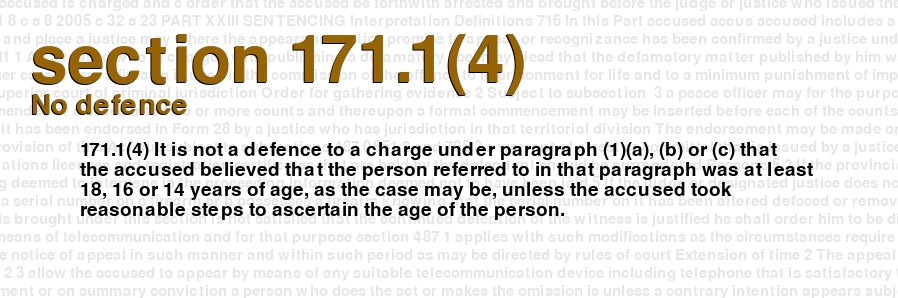
Introduction
Statutory Text
Explanation
Section 171.1(4) of the Criminal Code of Canada makes it clear that it is not a defence for the accused to claim that they believed a victim of sexual exploitation, prostitution, or trafficking was of a legal age. Regardless of any perception they may have had regarding the victim's age, they cannot use it as an excuse unless they had taken appropriate measures to verify the age of the victim. This provision aims to ensure that individuals engaging in exploitative activities with minors are held accountable and cannot use their lack of awareness as a way out of facing punishment.
Under this section of the Criminal Code of Canada, the burden is on the accused to demonstrate that they took reasonable steps to ascertain the age of the victim before engaging in exploitative activities. The Court will consider various factors to determine if the accused took appropriate measures to verify the age of the victim, including the nature of the relationship between the parties, the circumstances surrounding the incident, and any other relevant factors.
This provision in the Criminal Code helps to protect minors from sexual exploitation or trafficking and ensures that offenders are brought to justice, regardless of the perpetrator's perception of the victim's age. The law recognizes that individuals engaging in such activities must take reasonable precautions to ensure that their activities do not violate the law, and it places a significant responsibility on them to ensure that they are not engaging in exploitative activities with minors. As such, it acts as a deterrent, discouraging individuals from engaging in illegal activities and creating a safer environment for minors.
Commentary
Section 171.1(4) of the Criminal Code of Canada highlights the responsibility of the accused to take reasonable steps to ascertain the age of a person before engaging in certain prohibited activities. This provision serves as a protective measure for vulnerable individuals who may be at risk of exploitation or abuse, particularly those who are under the age of consent.
It is important to understand that the age of consent varies across the country. In Canada, the age of consent for sexual activity is generally 16 years old. However, there are exceptions to this rule depending on the age difference between the individuals involved and the nature of the relationship. For instance, if the individuals are in a position of authority or trust, the age of consent may be raised to 18 years old.
The provision in question applies to individuals who are charged with engaging in sexual activity or sexual exploitation of a person who is under the age of consent. The accused cannot use the defence that they believed the person in question was over the age of consent unless they took reasonable steps to ascertain their actual age.
The reasonableness of the steps taken by the accused will depend on the circumstances of each case. For instance, in cases where the individual is visibly underage, the accused may have a heightened duty to inquire about their age before engaging in sexual activity. On the other hand, if the individual presents themselves as being of legal age, the accused may have a lower duty to inquire about their age.
The purpose of this provision is to deter individuals from engaging in sexual activity or sexual exploitation of minors. It serves as a reminder to individuals that they have a responsibility to ensure that they are not engaging in unlawful behaviour. It also serves as a protective measure for minors, who may be unable to provide meaningful consent or may be vulnerable to manipulation by adults.
Overall, Section 171.1(4) of the Criminal Code of Canada is an important provision that reinforces the need for individuals to take responsibility for their actions. It highlights the importance of obtaining informed consent and serves as a protective measure for vulnerable individuals who may be at risk of exploitation or abuse. It also reinforces the message that sexual activity with minors is a serious offence that will be prosecuted to the fullest extent of the law.
Strategy
Section 171.1(4) of the Criminal Code of Canada is a provision that is relevant in cases where an individual is charged with sexual exploitation of minors. This section makes it clear that a belief by the accused that the victim was of legal age is not a defense, unless the accused took reasonable steps to ascertain the victim's age.
One of the strategic considerations when dealing with this section is the importance of conducting an effective investigation. It is crucial to gather evidence that demonstrates that the accused did not take reasonable steps to ascertain the victim's age. This can include evidence such as communications between the accused and the victim, witness statements, and surveillance footage. By presenting this evidence, the prosecution can attempt to establish that the accused should have known or did know that the victim was underage.
Another important consideration is the use of expert witnesses. Experts such as psychologists or forensic examiners can provide testimony to support the prosecution's case and to refute any claims by the accused that they believed the victim was of legal age. These experts can offer insights into the accused's behavior and thought processes at the time of the alleged offense, as well as provide an interpretation of any relevant evidence.
In addition, it is critical to consider the broader context of the case. This can include factors such as the age and vulnerability of the victim, the accused's relationship with the victim, and any history of sexual abuse by the accused. Factors like these can be considered by the court in determining the appropriate sentence for a conviction under section 171.1(4), and can also be used by the prosecution in advocating for a harsher sentence.
Strategies that could be employed in defending against a charge under this section could include attempting to demonstrate that the accused did take reasonable steps to ascertain the age of the victim, such as by presenting evidence of ID or other documentation. The defense may also seek to dispute the prosecution's interpretation of the evidence and may bring in their own expert witnesses to support their case.
In conclusion, section 171.1(4) of the Criminal Code of Canada is an important provision in cases involving sexual exploitation of minors. Strategic considerations when dealing with this section may include an effective investigation, the use of expert witnesses, and consideration of the broader context of the case. Strategies that could be employed in defending against a charge under this section may include demonstrating that the accused did take reasonable steps to ascertain the victim's age and disputing the prosecution's interpretation of the evidence.