Editorial Annotation
Exemption for Accused Aged Twelve or Thirteen
Introduction
Children aged 12 or 13 cannot be tried for certain sexual offences unless they have a specific relationship with the complainant.
Statutory Text
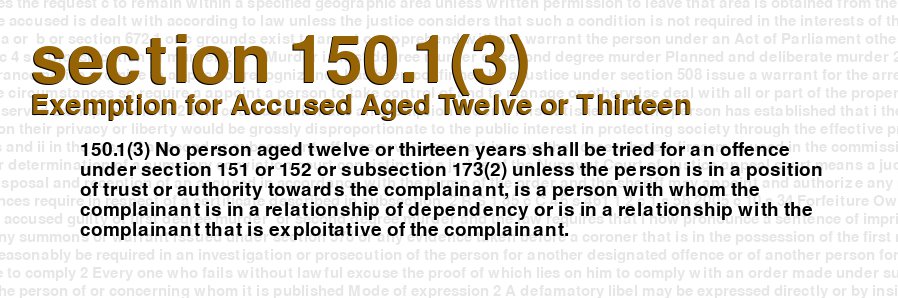
150.1(3) No person aged twelve or thirteen years shall be tried for an offence under section 151 or 152 or subsection 173(2) unless the person is in a position of trust or authority towards the complainant, is a person with whom the complainant is in a relationship of dependency or is in a relationship with the complainant that is exploitative of the complainant.
Explanation
Section 150.1(3) of the Criminal Code of Canada provides restrictions on the trial of individuals aged 12 or 13 years for certain offences. Specifically, this section pertains to the offences of sexual interference (section 151), invitation to sexual touching (section 152), and sexual exploitation (subsection 173(2)).
This provision states that a person aged 12 or 13 years cannot be tried for any of these offences unless they are in a position of trust or authority towards the complainant, are a person with whom the complainant is in a relationship of dependency, or are in a relationship with the complainant that is exploitative.
The intent of this section is to protect children from being unfairly prosecuted for sexual offences. The law recognizes that children aged 12 or 13 may not fully understand the consequences of their actions, and may be manipulated or coerced into committing sexual acts. This is particularly true in situations where there is a power imbalance between the child and the complainant, such as in cases of sexual exploitation or where the complainant is a person in a position of trust or authority.
In such cases, the child may not be considered capable of giving meaningful consent to sexual activity. Therefore, the law provides that the child cannot be held criminally responsible for these actions.
Overall, Section 150.1(3) underscores the importance of protecting children from sexual exploitation, and highlights the responsibility of those in positions of trust or authority to act in the best interests of the child.
Commentary
Section 150.1(3) of the Criminal Code of Canada states that no person aged twelve or thirteen years can be tried for an offence under section 151, 152, or subsection 173(2) unless the person is in a position of trust or authority towards the complainant, the complainant is in a relationship of dependency with them, or the relationship with the complainant is exploitative. This provision has been the subject of much debate, and this commentary will discuss its importance and main criticisms.
The purpose of the provision is to protect children who are below the age of consent from being criminalized for sexual conduct with other minors or under-aged individuals. The provision recognizes the vulnerability of children and the power dynamics that exist in relationships, especially when there is an age gap between the parties. It is also in line with Canada's commitment to the United Nations Convention on the Rights of the Child, which states that children have the right to be protected from all forms of sexual exploitation and abuse.
One of the main criticisms of the provision is that it conflates consensual sexual exploration between young people with sexual abuse. There is concern that it reinforces a punitive approach to adolescent sexuality and could lead to the stigmatization of young people. Some argue that the law should focus on creating spaces for young people to learn about sexuality in healthy and respectful ways, rather than criminalizing them for exploring their sexuality.
However, it is important to note that the provision only applies to cases where there is a position of power or exploitation, which means that cases of consensual sexual exploration between two minors would not be affected. The provision is designed to protect children from sexual abuse and exploitation by older individuals or those in positions of power. Research has shown that young people who experience sexual abuse are more likely to suffer from mental health problems, substance abuse, and other negative outcomes.
Another criticism of the provision is that it does not go far enough in protecting children from sexual abuse. Some argue that the age limit should be raised to sixteen or eighteen, to better reflect the age of consent in Canada. However, others argue that the current age limit is appropriate because it recognizes that young people do engage in sexual activity, and provides a balance between protecting children from abuse and recognizing their emerging sexuality.
It is also important to note that the provision does not exempt children who are in a position of power or authority from being charged with sexual offences. If a child is in a position of power or authority over another child, they can still be charged with sexual offences under the Criminal Code.
In conclusion, section 150.1(3) of the Criminal Code of Canada is an important provision designed to protect children from sexual abuse and exploitation. While there are some criticisms of the provision, it strikes a balance between protecting children and recognizing their emerging sexuality. Ultimately, the provision aims to ensure that children are not criminalized for acts that are beyond their control, and that they are protected from those who would seek to harm them.
Strategy
When dealing with Section 150.1(3) of the Criminal Code of Canada, it is important to consider the specific circumstances of the case and the potential consequences of pursuing legal action against a person aged twelve or thirteen.
One strategic consideration is whether it is in the best interests of the complainant to pursue charges against the young person. Depending on the nature of the offence and the relationship between the parties involved, the complainant may not want to subject the young person to criminal proceedings. This could be especially relevant if the young person is a family member or close friend.
Another consideration is the potential impact of a criminal conviction on the young person's future. A criminal record could have long-lasting consequences, affecting the young person's ability to obtain employment, travel, or engage in other activities. This could be a significant consideration in cases where the offence is relatively minor or where the young person has no prior criminal record.
In cases where it is determined that pursuing charges against the young person is necessary, there are a number of strategies that could be employed. One option is to seek a diversion program, which would allow the young person to avoid a criminal conviction by completing educational or community service requirements. Another option is to seek a conditional discharge, which could allow the young person to avoid a criminal record by completing certain conditions, such as attending counselling or community service.
It is also important to involve legal counsel in the process of dealing with section 150.1(3) of the Criminal Code. An experienced criminal defence lawyer can help to navigate the complexities of the criminal justice system and provide guidance on the most appropriate strategies to pursue.
Overall, when dealing with young persons who are subject to section 150.1(3) of the Criminal Code, it is important to consider all of the potential consequences and to seek the advice of legal counsel before pursuing any course of action. By taking a thoughtful and strategic approach, it may be possible to achieve a favourable outcome for all parties involved.