Editorial Annotation
Evidence in Specific Cases
Introduction
Statutory Text
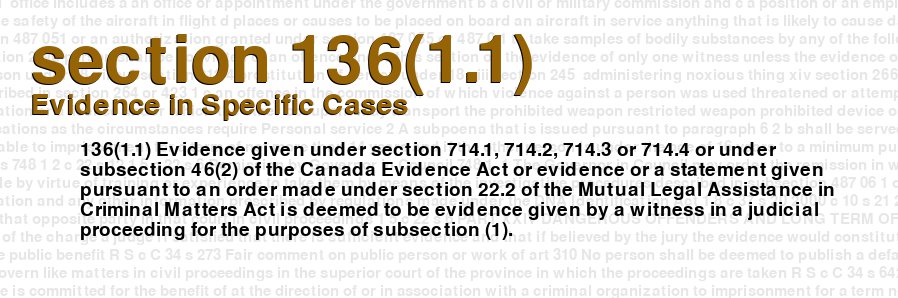
136(1.1) Evidence given under section 714.1, 714.2, 714.3 or 714.4 or under subsection 46(2) of the Canada Evidence Act or evidence or a statement given pursuant to an order made under section 22.2 of the Mutual Legal Assistance in Criminal Matters Act is deemed to be evidence given by a witness in a judicial proceeding for the purposes of subsection (1).
Explanation
Section 136(1.1) of the Criminal Code of Canada deals with the admissibility of evidence in criminal proceedings. It states that evidence given under specific sections of the Canada Evidence Act or the Mutual Legal Assistance in Criminal Matters Act is deemed to be evidence given by a witness in a judicial proceeding for the purposes of subsection (1).
Subsection (1) of section 136 of the Criminal Code allows for the admission of previous statements made by a witness in judicial proceedings. This means that if a witness has previously given a statement in a court or other legal setting, that statement can be used as evidence in a subsequent trial. The purpose of this is to ensure that the evidence provided by a witness is consistent and reliable.
Section 136(1.1) expands on this by including evidence given under specific sections of the Canada Evidence Act, which deals with the admissibility of evidence in legal proceedings, and the Mutual Legal Assistance in Criminal Matters Act, which involves the sharing of evidence between different countries.
Essentially, this section helps to ensure that evidence provided by witnesses in previous legal proceedings or pursuant to specific legal orders can be used in subsequent criminal proceedings. This helps to ensure that justice can be served and that all relevant evidence can be considered in a fair and comprehensive manner.
Commentary
Section 136(1.1) of the Criminal Code of Canada was introduced in 2008 to simplify the use of extrajudicial evidence in criminal proceedings. This section allows evidence given under specific sections of the Canada Evidence Act and the Mutual Legal Assistance in Criminal Matters Act to be deemed as evidence given by a witness in a judicial proceeding for the purposes of subsection (1).
This provision is significant because it provides a statutory exception to the common law rules around hearsay evidence. Hearsay evidence refers to out-of-court statements that are being used to prove the truth of its contents. In general, hearsay evidence is considered unreliable and thus inadmissible in court. However, section 136(1.1) creates a specific exception for certain types of extrajudicial evidence to be used in criminal proceedings.
One type of extrajudicial evidence that is covered by this provision is evidence given under sections 714.1 to 714.4 of the Canada Evidence Act. These sections allow for certain categories of witnesses, such as police officers and certain experts, to give evidence by way of affidavit rather than appearing in court. Prior to the introduction of this section, such evidence would need to meet the requirements of the common law rules around hearsay evidence, which are often complex and difficult to apply.
Similarly, evidence given under subsection 46(2) of the Canada Evidence Act is covered by this provision. Subsection 46(2) allows for prior consistent statements to be admitted in order to bolster a witness's testimony. These types of statements would not ordinarily be admissible under the hearsay rule, but section 136(1.1) renders them admissible when given under this subsection.
Finally, evidence given pursuant to an order made under section 22.2 of the Mutual Legal Assistance in Criminal Matters Act is also included in this provision. This section allows for evidence to be obtained from foreign jurisdictions and used in Canadian criminal proceedings. This can include statements made by witnesses or accused persons who are located abroad. Previously, such evidence would need to meet the common law requirements for hearsay evidence, which can be challenging in cross-border cases.
Overall, section 136(1.1) of the Criminal Code of Canada is an important provision that simplifies the use of extrajudicial evidence in criminal proceedings. By deeming certain types of evidence to be admissible as if they were given by a witness in a judicial proceeding, this provision makes it easier for prosecutors to use evidence that would otherwise be excluded under the hearsay rule. This can be particularly important in complex criminal cases where obtaining admissible evidence can be challenging. However, it is also important to note that this provision is subject to certain limitations and should be used with caution to ensure that the rights of accused persons are protected.
Strategy
Section 136(1.1) of the Criminal Code of Canada deems evidence given in certain circumstances to be evidence given by a witness in a judicial proceeding. This has important implications for lawyers who are dealing with cases where this section is applicable. Here are some strategic considerations and strategies that lawyers might employ in such cases.
1. Understanding the scope of the section. Lawyers need to be aware of the specific circumstances under which this section applies (section 714.1, 714.2, 714.3 or 714.4 of the Criminal Code, subsection 46(2) of the Canada Evidence Act, or an order made under section 22.2 of the Mutual Legal Assistance in Criminal Matters Act). They also need to understand what "evidence" and "statement" mean in this context.
2. Assessing the reliability of the evidence. Just because evidence is deemed to be evidence given by a witness in a judicial proceeding doesn't mean it's automatically admissible. Lawyers should assess the reliability of the evidence and consider whether it meets the standard for admissibility.
3. Preparing to challenge the evidence. Lawyers may need to challenge the admissibility of evidence deemed to be evidence given by a witness in a judicial proceeding. They should be prepared to make arguments about the reliability of the evidence, the sufficiency of the procedure used to obtain it, and any other relevant factors.
4. Considering the impact of the evidence on the case. Even if lawyers are unable to exclude evidence deemed to be evidence given by a witness in a judicial proceeding, they should consider the impact of that evidence on the case. They may need to adjust their strategy accordingly, focusing on other evidence or arguments that could counteract the impact of the deemed evidence.
5. Using the section strategically. Lawyers may be able to use section 136(1.1) to their advantage. For example, if they have obtained evidence through section 714.1, they can rely on the fact that it has been deemed to be evidence given by a witness in a judicial proceeding to bolster its credibility.
In conclusion, lawyers need to be aware of section 136(1.1) of the Criminal Code of Canada and the strategic considerations that come with it. They should carefully evaluate the admissibility and impact of evidence deemed to be evidence given by a witness in a judicial proceeding, and be prepared to make arguments in support of their position. Ultimately, the goal is to achieve the best possible outcome for their client while ensuring that justice is served.