Editorial Annotation
Exception
Introduction
Possession of a firearm with altered serial number is not an offense if it has been replaced with a new serial number and registered.
Statutory Text
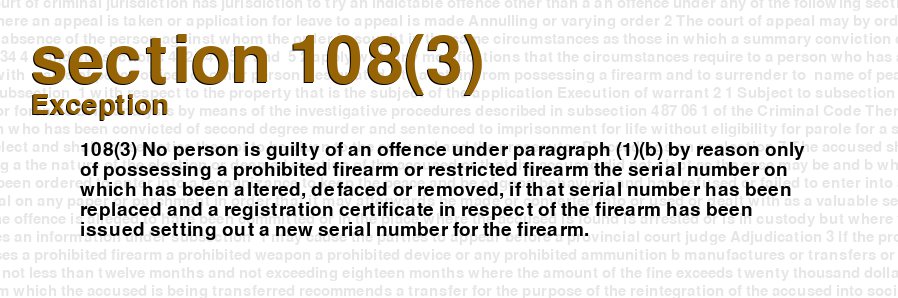
108(3) No person is guilty of an offence under paragraph (1)(b) by reason only of possessing a prohibited firearm or restricted firearm the serial number on which has been altered, defaced or removed, if that serial number has been replaced and a registration certificate in respect of the firearm has been issued setting out a new serial number for the firearm.
Explanation
Section 108(3) of the Criminal Code of Canada provides an exemption from criminal liability for possessing a prohibited or restricted firearm that has a defaced, altered or removed serial number if the owner has replaced the original serial number and obtained a registration certificate setting out the new serial number. The purpose of this exemption is to prevent law-abiding firearm owners from being unfairly penalized for possessing a firearm with a damaged serial number that they were not responsible for.
Under paragraph 108(1)(b), it is an offence to possess a prohibited or restricted firearm that has a defaced, altered or removed serial number. The penalty for this offence is a maximum of 10 years imprisonment. However, if the owner of the firearm has replaced the defaced serial number and obtained a registration certificate for the firearm with the new serial number, they will not be guilty of an offence under this section.
The registration certificate is a document issued by the Chief Firearms Officer that confirms the firearm's ownership and provides information about the firearm, including its make, model, and new serial number. Obtaining a registration certificate requires the firearm owner to demonstrate that they are eligible to own the firearm under the law.
Overall, section 108(3) of the Criminal Code of Canada provides an important exemption for law-abiding firearm owners who have taken steps to rectify a damaged serial number on their firearm, ensuring that they are not unfairly penalized for an unintentional act.
Commentary
Section 108(3) of the Canadian Criminal Code is an important provision that deals with the possession of prohibited or restricted firearms that have had their serial numbers altered, defaced or removed. The section provides that an individual possessing such firearms will not be guilty of an offence under paragraph (1)(b) if a new serial number has been assigned and registered with the appropriate authorities.
The purpose of this provision is to make it difficult for individuals to possess firearms that have been illegally altered. The serial number of a firearm is an essential part of its identification, and any alteration or removal thereof makes it difficult for law enforcement to trace the weapon back to its original owner or source. By requiring the registration of firearms with new serial numbers, the provision ensures that law enforcement can still identify and track firearms that have been illegally modified.
There are two key components of Section 108(3) that are worth noting. Firstly, the provision only applies to firearms that have been registered with new serial numbers. This means that individuals cannot simply alter the serial number of a firearm and claim immunity under Section 108(3). They must also ensure that the firearm has been re-registered with a new serial number.
Secondly, the provision only applies to possession. It does not provide immunity for individuals who alter, deface or remove serial numbers from firearms or who are involved in any other illegal activities related to firearms. This means that individuals who are caught altering serial numbers on firearms or engaging in other illegal activities will not be immune from prosecution under Section 108(3).
Overall, Section 108(3) strikes a good balance between public safety and individual rights. It acknowledges the importance of serial numbers in identifying firearms and their owners, while also providing a way for individuals to possess firearms that may have been illegally altered. At the same time, it makes it clear that individuals who engage in any illegal activities related to firearms are not immune from prosecution.
In conclusion, Section 108(3) of the Canadian Criminal Code is an important provision that provides immunity to individuals who possess firearms with illegally altered serial numbers if the firearm has been re-registered with a new serial number. The provision strikes a good balance between public safety and individual rights, while also making it clear that individuals who engage in illegal activities related to firearms will not be immune from prosecution.
Strategy
Section 108(3) of the Canadian Criminal Code provides an exception to the offence of possessing a prohibited firearm or restricted firearm with an altered, defaced or removed serial number, under certain circumstances. Specifically, individuals who possess a firearm with an altered serial number can avoid criminal liability if the serial number has been replaced, and a registration certificate has been issued for the firearm, setting out the new serial number.
Some strategic considerations when dealing with this section of the Criminal Code may include the following:
1. Legal representation: Given the complexity of firearms laws and regulations in Canada, it is essential to seek legal representation from an experienced criminal defence lawyer who can help navigate the issues surrounding firearms possession, modification, and registration.
2. Compliance with firearms regulations: To take advantage of the exemption provided by section 108(3), it is crucial to ensure that all regulations related to firearms possession and registration are followed. This may include obtaining the necessary licenses and permits, complying with safe storage requirements, and keeping the registration certificate updated.
3. Documenting the firearm: The onus is on the firearm owner to prove that the firearm was legally obtained and registered with an updated serial number. As such, it is essential to keep detailed records, including purchase receipts, transfer of ownership documents, and registration certificates.
4. Cooperation with law enforcement: Individuals with firearms with altered or removed serial numbers should inform law enforcement as soon as possible to avoid legal complications. Cooperating with the authorities demonstrates a willingness to comply with regulations and laws.
Some strategies that could be employed include identifying potential issues with firearms possession and registration, seeking counsel from experienced firearms lawyers, and complying with all firearms-related regulations. Individuals can also work proactively with law enforcement to ensure firearms are properly registered and documented.
Conclusion:
Section 108(3) of the Criminal Code of Canada provides an exemption to persons possessing prohibited or restricted firearms with altered or removed serial numbers. The exemption's conditions must be met to avoid criminal liability. Strategic considerations when dealing with this section of the Criminal Code involve securing legal representation, complying with all firearms-related regulations, documenting the firearm, and cooperating with law enforcement. Employing these strategies can help individuals avoid legal complications related to firearms possession and registration in Canada.