Editorial Annotation
Definition of Public Place
Introduction
The definition of a public place in this section includes any place accessible to the public by right or invitation.
Statutory Text
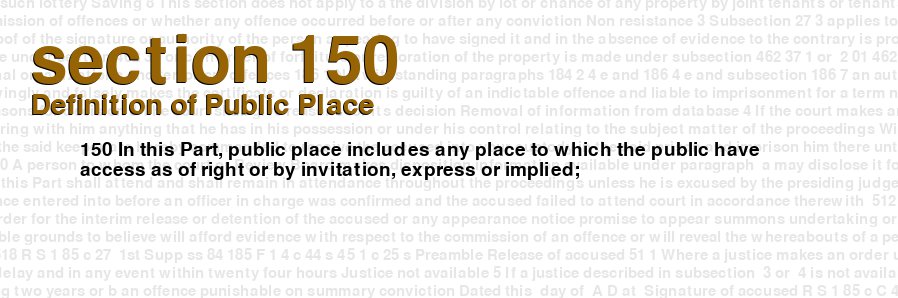
150 In this Part, "public place" includes any place to which the public have access as of right or by invitation, express or implied;
Explanation
Section 150 of the Criminal Code of Canada defines the term "public place" as it relates to Part V of the Code, which deals with offences against public order. The section states that a public place includes any location that is accessible to the general public by right or by invitation, either explicitly or implicitly.
This definition is essential to the interpretation of the criminal offenses outlined in Part V of the Code, as many of these offences are only considered crimes if they are committed in a public place. Some examples of offences that require a public place include causing a disturbance, behaving in a disorderly manner, and engaging in indecent public acts.
The inclusion of both explicit and implied invitations in the definition of a public place is also important. An explicit invitation would be an open invitation made by the owner of the property, while an implied invitation would arise when a person enters a location without being expressly denied access. This means that individuals cannot necessarily argue that they did not know they were in a public place if they entered without express invitation.
Overall, Section 150 of the Criminal Code provides a clear definition of what constitutes a public place for the purposes of Part V of the Code. This is important for the effective enforcement of public order offences and ensuring the safety and well-being of Canadian citizens in public spaces.
Commentary
Section 150 of the Criminal Code of Canada is an essential provision that defines the term "public place." The section outlines the meaning of the phrase as any place that is readily accessible to the public for any purpose, either through invitation or by right. This provision is incredibly relevant in determining the legal status of various public spaces, especially in Canadian courts.
The primary purpose of this provision is to provide a legal definition of what encompasses a public place. This provision encompasses areas that may be privately owned but are used regularly by the public as commonly accepted areas associated with public use. Public places include areas such as parks, public streets, sidewalks, public buildings, and other similar areas. A public place can also refer to a private space but is open to the public through specific means.
The breadth of the phrase "public place" allows for considerable protection for victims involved in cases such as sexual assault and harassment. Suppose an individual is a victim of a sexual crime. In that case, the person must provide evidence that the crime occurred in a public area explicitly defined by section 150 of the Criminal Code. Therefore, proving that the criminal act was committed in a public place provides the victim with required legal support to proceed with a criminal case.
Moreover, the provisions of section 150 of the Criminal Code in Canada are not restricted by any geographical location specification. This means that a public space can be anywhere, regardless of whether it is publicly or privately owned. Therefore, Section 150 of the Criminal Code of Canada ensures that those found guilty are not able to escape liability by arguing that the crime was committed in a location not considered a public place.
This section also makes provisions for situations where access to the public space is through an implied invitation. For instance, if an establishment has a parking area for customers, the parking lot can be deemed a public place, even if it is privately owned by the establishment. This is because there is an invitation, although only implied, to visit the location before entering the store. This is relevant because it ensures that a victim can still be protected by the Criminal Code of Canada, regardless of whether the space is technically private or publicly owned.
In summary, Section 150 of the Criminal Code of Canada is essential to the Canadian legal system. This section ensures that the public is protected by providing a clear definition of what constitutes a public place. This definition ensures that victims of criminal acts that occur in public places can be protected by the law. Furthermore, the provision concerning implied invitations means that even privately-owned spaces can be considered public places if there is an implicit or express invitation to the public. This broad interpretation fosters transparency and fairness within the criminal justice system.
Strategy
Section 150 of the Criminal Code of Canada is an important provision in Canadian criminal law. It broadens the definition of "public place" to any location that the public can access, whether by right or invitation, expressed or implied. This includes open spaces such as streets, parks, and sidewalks, as well as privately owned spaces such as shopping malls and office buildings. Prosecution under section 150 requires that an individual intentionally expose themselves in a "public place," making it a popular tool for law enforcement seeking to curb public sexual acts.
Strategic considerations
As with any provision in the Criminal Code, law enforcement must employ strategic considerations when deciding when and how to enforce section 150. Some strategic considerations that should be kept in mind include:
1. Balancing community safety versus individual rights
The broad definition of "public place" in section 150 presents complexities when balancing community safety with individual rights. It is crucial to balance the need to protect the public from harmful acts in public places while ensuring that individuals' constitutional rights are respected.
2. Resource allocation
The number of individuals caught under section 150 is relatively low, meaning police departments may not necessarily want to allocate scarce resources towards enforcing this provision. Departments should make sure they allocate resources accordingly, taking into account the rate of catchment of those committing offenses under this provision.
3. Evidence requirements
Since exposure must be done intentionally, proving a violation under this section requires strong evidence to show that a person "willfully" exposed themselves. Having sufficient and reliable evidence becomes crucial in enforcing this provision.
4. The need for discretion
Enforcement under section 150 requires discretion. The sensitivity surrounding nudity means that, in some cases, officers may need to take different tactics, for instance using more discretion when enforcing situations that are minor.
Strategy considerations could influence how to apply any of the following strategies:
Strategies to employ
1. Education and awareness
Educating the public extensively on section 150 and the consequences of violating it can, to a great extent, reduce the incidents of public nudity and hence violations under section 150.
2. Community policing
Community policing strategies such as security patrols and public awareness campaigns can help reduce public exposure and curb violations of section 150.
3. Proactive Patrols and Surveillance
A proactive approach to enforcement of section 150 demands an increased number of patrols and surveillance in public places to deter potential exposure.
4. Collaboration and partnering
Collaborating with partners in various sectors, including the youth, sporting groups, the media, and religious institutions, can reduce the incidents of violations as it instills behavioral change and creates public awareness.
5. Bait Operations
Bait operations consist of police officers posing as individuals passing near a public location in a bid to catch potential violators in such a public place.
FINAL WORDS
Effective implementation of strategies when enforcing Section 150 of the Criminal Code of Canada is essential. While it is a useful tool to curb public exposure and acts of public nudity, police departments and law enforcement officials must ensure that the individual rights of the accused are respected. The use of discretion when enforcing section 150, coupled with effective strategies targeting awareness creation, collaboration, surveillance, proactive patrols, and bait operations, can help reduce the incidents of violations and consequently protect the public.